
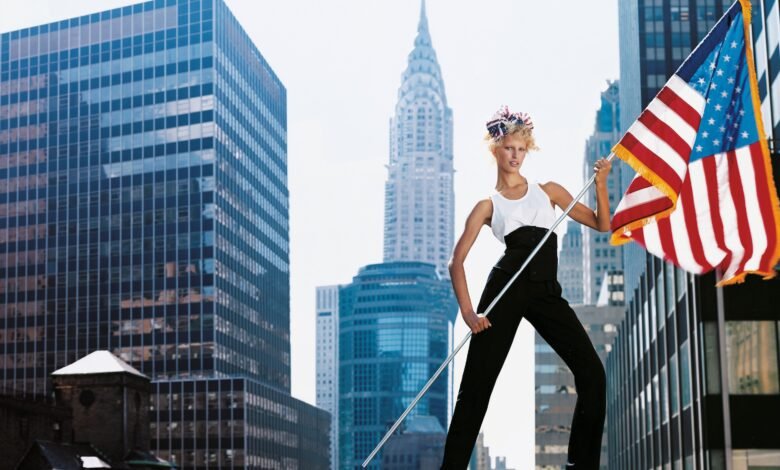
“Amazing Grace,” by Sally Singer, was originally published in the November 2001 issue of Vogue. For more of the best from Vogue’s archive, sign up for our Nostalgia newsletter here. Unusual times call for unusual measures. In these pages, we offer a preview of American fashion for spring 2002—an exception to our standard practice of showing only designs that are, or will imminently be, available for purchase by the time Vogue lands on the newsstand.
The looks here will not be in stores for a few months yet, but the qualities that underlie them—optimism, vivacity, confidence—speak to us with irresistible urgency. Perhaps a special showcasing of work that, under normal circumstances, would have been presented under the tents in Bryant Park, Manhattan, simply gratifies our instinct for patriotic self-expression. Up until September 11, the New York collections had proceeded with predictable doses of giddiness (Imitation of Christ insisted that the viewers walk down the catwalk while the mod- els occupied the front row) and tedium (why was getting into Marc Jacobs’s show a dismal throwback to the velvet-rope frustrations of the Mike Todd room at the Palladium, circa 1986?).
Then came Tuesday. All shows were canceled, and it was not until the following week that the industry felt able to go on, and then only in a sober, scaled-back form. Small groups of editors were invited to no-frills Seventh Avenue showrooms to see a selection of a designer’s key looks, often without music. Punctual, celebrity- and goodie- bag-free, these events constituted a new kind of fashion moment.
All the designers made a few grateful
All the designers made a few grateful and sorrowful remarks, and all asserted their unshakable commitment to city and country. For those of us with bottled-up grief and an unspoken hunger for hope, the shows offered catharsis, as well as a bracing example of indomitable resolve. At Donna Karan (who revealed that September 11 was the anniversary of her wedding to her late husband), many wept as schmaltzy love songs by Sting, Celine Dion, and the like suddenly acquired an unexpected potency.
Likewise, American fashion revealed its core strengths. Recently derided in some quarters for its failure to match the theatrics of Paris, the innovativeness of London, or the ineffable sexiness of Milan, New York showed its true colors as the world’s center for truly great sportswear: the right narrow pant (sarong-y at Michael Kors, in coral denim at Marc by Marc Jacobs), the rethought trench (corset-backed at Narciso Rodriguez, light-as-air at Donna Karan), and the crisp white shirt (skinny poplin at Carolina Herrera, jacket-size at Calvin Klein).
These unbeatable basics and classic separates resonated as never before, since they solved, with a total lack of fuss and bother, the problem of what to wear when you have weightier things on your mind than fashion. Similarly, the essential piece for spring from every American designer is the low-key dress for day or night. At Bill Blass, Lars Nilsson offers a sequined shirtdress of appealing slouchiness.
Michael Kors revives the spirit of Halston
Michael Kors revives the spirit of Halston with a stretch-silk halter in Chinese red. Marc Jacobs’s swingy jersey numbers—adorned with patches and appliqués—reawakens Sant’Angelo and Stephen Burrows for a new generation. Calvin Klein cuts layered sheaths, with thirties seaming, out of plum tulle. Here’s what makes these dresses more than the sum of their pedigree, and thus modern: an uncluttered prettiness that does not drown the wearer in a sea of twee.
You’ll pair them with a flat sandal or something high and strappy, and be off. Dress and go. Life should always be that simple. Other treats from the home team? Hearty lace, and lots of it: eyelet for corsets at Oscar de la Renta, Battenberg on bibs and hems at Miguel Adrover, beaded and gauzy in the most romantic prairie skirts ever from Ralph Lauren, guipure in a strapless dress from Behnaz Saraf-pour.
Homespun finishes and fabrics: quilting at Jacobs and Adrover, crewel embroidery at Blass, washed pajama striping in a coat lining at Marc, linen shenanigans at Donna Karan. The mood is warm, friendly, and domestic, even when the silhouette is slick and narrow. And herein lies the essence of how to dress now. It goes almost without saying that recent trends such as black and military and urban warrior have lost much of their too-cool, too-knowing appeal.
This doesn’t mean that we can’t wear all
This doesn’t mean that we can’t wear all those fabulous items we bought for fall—the combat boots and pseudo-armor jackets and Cossack coats—but we’ll have to do it in a way that acknowledges the intrinsic beauty of their design. Much has been made in the culture pages about how the attacks signaled the end of irony in American popular discourse. It would be a shame if fashion lost its humor and sly, subversive streak.
Defeatist fashion is the last thing we want—and, it so happens, the last thing that our American designers would think of giving us.
Source: www.vogue.com